Semantic Keyword Grouping for Google Search Console Queries
Semantic keyword grouping clusters queries that share the same meaning and search intent so you can assign one target page instead of writing thin pages for every keyword variation. SEOcluster.ai groups real Google Search Console queries by meaning—then shows ownership, cannibalization risk, and what to brief next. Built for SEO agencies and freelancers who need page decisions, not keyword dumps.
Turn semantic keyword groups into Target Pages, compare with tools like Ahrefs Parent Topic, and generate content actions before writers start.
Works best with 1,000+ keywords · No credit card required
What Is Semantic Keyword Clustering and Grouping?
Semantic keyword clustering, also called semantic keyword grouping, is the process of grouping keywords based on shared meaning and search intent rather than exact word matches.
Instead of creating separate pages for:
"bird vet""avian veterinarian""exotic bird vet"Semantic clustering recognises these as variations of the same intent — and groups them into a single, authoritative topic.
One intent → one cluster → one Target Page.
How Semantic Keyword Grouping Works
Semantic grouping looks beyond repeated words. It identifies queries that mean the same thing, queries that support the same page, and queries that should be separated because the searcher wants a different outcome.
- Same meaning: variations, synonyms, and related phrases belong together.
- Same intent: keywords are grouped when they can be answered by one page.
- Same action: each group becomes a clear create, optimize, merge, or monitor decision.
Keyword grouping
Groups similar phrases together so a keyword list becomes easier to review.
Semantic clustering
Groups queries by meaning and intent, then decides whether one page can satisfy the topic.
GSC-native clustering
Adds clicks, impressions, ranking URLs, and page ownership signals from your own site.
Why Traditional Keyword Clustering Falls Short
Most keyword tools cluster using:
- •Word overlap
- •Regex rules
- •Shared SERP URLs
This often leads to:
Over-segmentation
Duplicate content
Cannibalisation
Confusing content plans
Semantic clustering solves this by focusing on meaning, not spelling.
How SEOcluster.ai Performs Semantic Clustering
SEOcluster.ai uses a hybrid clustering engine: semantic analysis groups by meaning, SERP data validates against Google's results, and AI refinement combines related clusters into actionable target pages.
Once clusters are mapped to target pages, the AI SEO Audit helps validate page-level issues that may be holding those target pages back.
This allows the system to:
Pro users can enable MPNet High Accuracy Mode in settings to improve semantic precision on large or complex datasets.
MPNet is designed to reduce over-fragmentation and better identify likely vocabulary variants, while allowing distinct niche intents to remain separate when signals differ. Best suited for 25k+ keywords and closely related service terms.
Automatic Cluster Merging & Cannibalisation Prevention
SEOcluster.ai doesn't stop at initial clustering.
It also:
Detects Overlaps
Identifies semantically overlapping clusters
Suggests Merges
Recommends intelligent cluster combinations
Prevents Cannibalisation
Stops multiple pages targeting the same intent
This reduces:
- Duplicate pages
- Internal competition
- Content bloat
And helps build clean topical entities Google can understand.
Semantic Clustering & Topical Authority
Topical authority is built when:
- Related queries are covered comprehensively
- Content depth matches user intent
- Pages clearly relate to each other
Semantic clusters help you:
- Plan pillar pages and supporting content
- Avoid gaps in topic coverage
- Structure content hubs logically
This is critical for: Competitive SEO, AI Overviews, and Generative Engine Optimisation (GEO).
From Target Pages to Publish-Ready Content
Each Target Page can be turned into:
Structured SEO content brief
Combined briefs (merged clusters)
Intent-aligned FAQs
Schema guidance
Full landing page
SEO Strategy Draft (PDF)
Audits summarise Target Pages, quick wins, cannibalisation, and next actions in a shareable format.
Briefs are designed to:
- Match search intent
- Cover topics holistically
- Be easy to execute with writers or teams
Create, Optimize, Merge, or Monitor
The real value of semantic clustering is the page decision. SEOcluster.ai connects every cluster to your existing Google Search Console evidence so you can decide whether the topic needs a new page, a stronger existing page, a merge review, or simple monitoring.
Create
No strong existing URL owns the topic, so the cluster becomes a new target page.
Optimize
One page already has visibility and should be strengthened for the whole intent.
Merge
Related clusters or URLs share the same search intent and need consolidation review.
Monitor
Signals exist, but the data is not strong enough to justify risky page changes.
Why Google Search Console data matters
A normal keyword grouping tool can tell you that queries look similar. SEOcluster.ai can also show which URL Google already associates with the topic, whether another URL is competing, and whether the opportunity is based on impressions, clicks, position, or a content gap.
From Clusters to Target Pages
Semantic clustering is just the start. SEOcluster.ai shows you the Target Pages you need to create, optimize, or merge.
Target Pages Output
Don't just see clusters — see the specific pages you need. Each Target Page shows combined keywords, volume, existing URL status, recommended action, and competitor content gaps flagged directly on the card.
Page Strategy
AI identifies topic branches that should be combined into single pages. Generate combined content briefs covering all related clusters — adapted to your site type (service business, ecommerce, or publisher).
URL Mapping
Each cluster is mapped to existing URLs from GSC data with five recommended actions:
- • Optimize • Strengthen
- • Choose Primary • Create
- • Monitor
Matrix View
Visualize your entire topic landscape in a hierarchy: primary topics, secondary subtopics, and long-tail variations. Plan content architecture at a glance.
Merge Recommendations
AI identifies overlapping clusters and recommends merges, preventing cannibalisation before you publish.
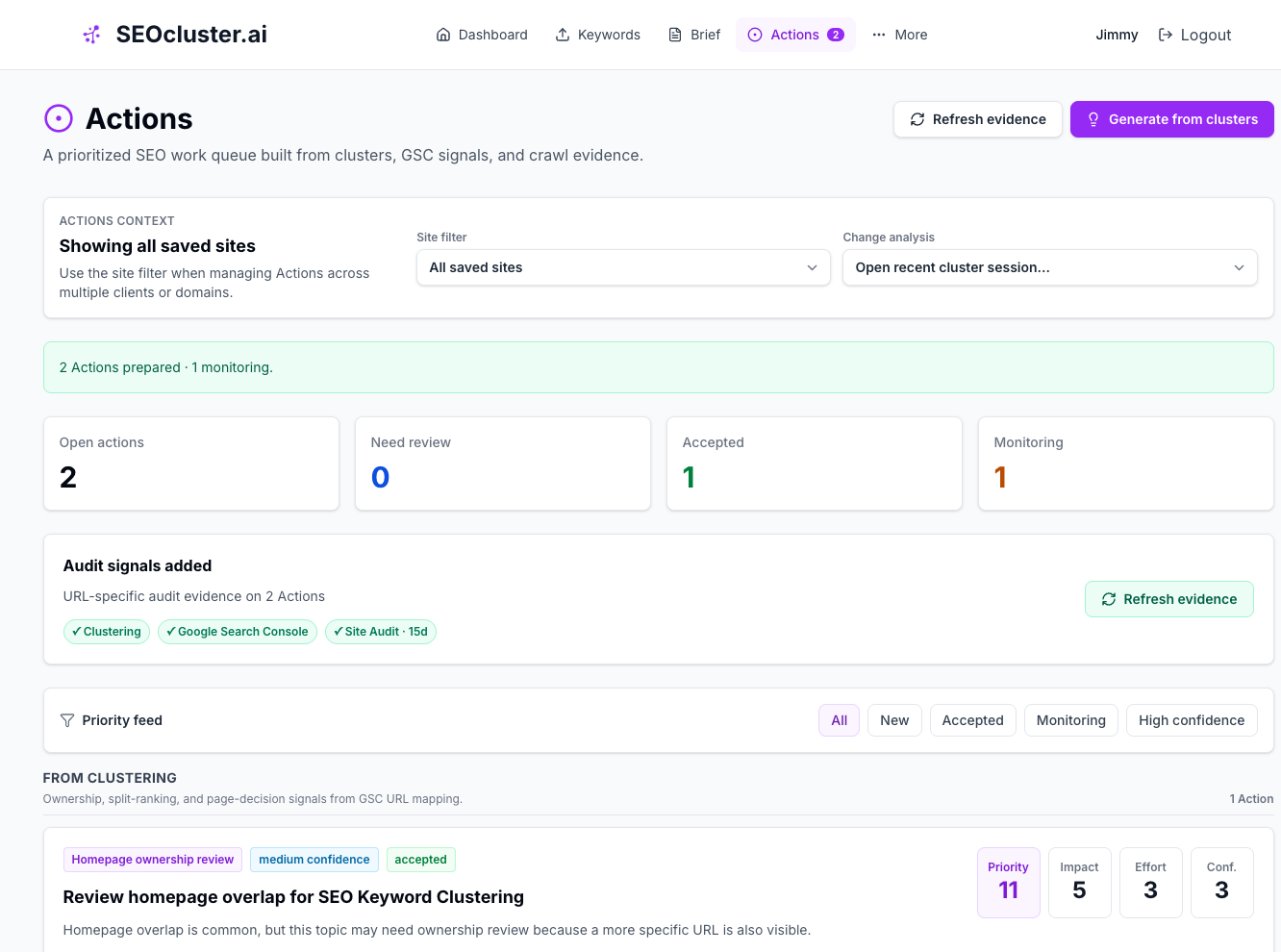
Clusters become review-ready Actions
Keyword clusters are evidence, not the final decision. SEOcluster.ai turns the strongest cluster and URL-mapping signals into a prioritized Actions queue with confidence, evidence sources, and safe implementation notes.
Who Benefits from Semantic Keyword Clustering?
SEOcluster.ai is ideal for:
SEO agencies
Managing complex sites and multiple clients
In-house teams
Scaling content production efficiently
Businesses building topic hubs
Creating comprehensive content ecosystems
SEOs targeting competitive keywords
Needing precision and depth
If you want to stop guessing which keywords belong together, semantic clustering is essential.
For the strategy behind this workflow, read the intent-based keyword clustering guide.
Ready to Cluster Keywords by Meaning, Not Guesswork?
Start Free with Google Search ConsoleNo credit card required
Common Questions
Is semantic clustering better than SERP-based clustering?
Semantic clustering focuses on meaning and intent, while SERP-based clustering relies on ranking similarity. Both have value, but semantic clustering is more effective for building topical authority. See our detailed comparison for a full breakdown, or compare this workflow with Ahrefs Parent Topic clustering.
Can I use semantic clustering with non-GSC keywords?
Yes. You can upload keyword lists via CSV, and SEOcluster.ai will cluster them by intent.
What is the difference between semantic keyword clustering and keyword grouping?
Keyword grouping usually means collecting similar phrases together. Semantic keyword clustering goes further by deciding whether those queries share the same meaning, intent, and target page.
Why use Google Search Console data for clustering?
GSC shows the pages Google already tests for each query. That lets SEOcluster.ai turn clusters into page ownership decisions instead of static keyword lists.
Does semantic clustering help with AI Overviews?
Yes. Clear intent alignment and entity-level coverage improve eligibility for AI-generated search results.
What are Target Pages?
Target Pages are the actionable output of semantic clustering. Instead of just showing clusters, SEOcluster.ai shows you the specific pages you need to create, optimize, or merge — with combined keywords, search volume, and existing URL status for each.
Go deeper with these resources
Build Clear Topic Clusters That Actually Rank
Start Free with Google Search ConsoleNo credit card required · Cancel anytime