From 2,000 GSC Queries to 18 Pages: How Hybrid Clustering Reveals the Right Site Structure
SEO advice often starts with keywords. This case study starts with pages. I analysed 2,000+ real Google Search Console queries from a local vet website using hybrid clustering — semantic analysis, SERP validation, and AI refinement — to find exactly how many pages the site actually needed.
The Key Finding
2,000+ keywords collapsed into 21 clusters and 18 target pages. Not the 40+ pages you'd expect from keyword research, and not over-compressed into too few either. The AI refinement layer caught synonym clusters that would have caused cannibalisation as separate pages. The tool didn't just group keywords — it reverse-engineered the site's architecture based on search intent.
The Assumption: More Keywords = More Pages
The assumption was simple and common: identify keywords, create pages for each topic, rank for everything.
With 2,000+ queries in Google Search Console, you might expect dozens of content opportunities. Different keywords, different pages, right?
Google didn't agree.
What Hybrid Clustering Revealed
After running the GSC queries through three layers of analysis — semantic grouping, SERP validation, and AI refinement — the site structure became clear:
21
keyword clusters from 2,000+ GSC queries
18
target pages recommended
523
keyword variants consolidated
3
layers of analysis (semantic + SERP + AI)
The same few URLs kept ranking for multiple keyword clusters. This wasn't a content gap problem — it was a structure problem. And solving it required more than just grouping keywords by similarity.
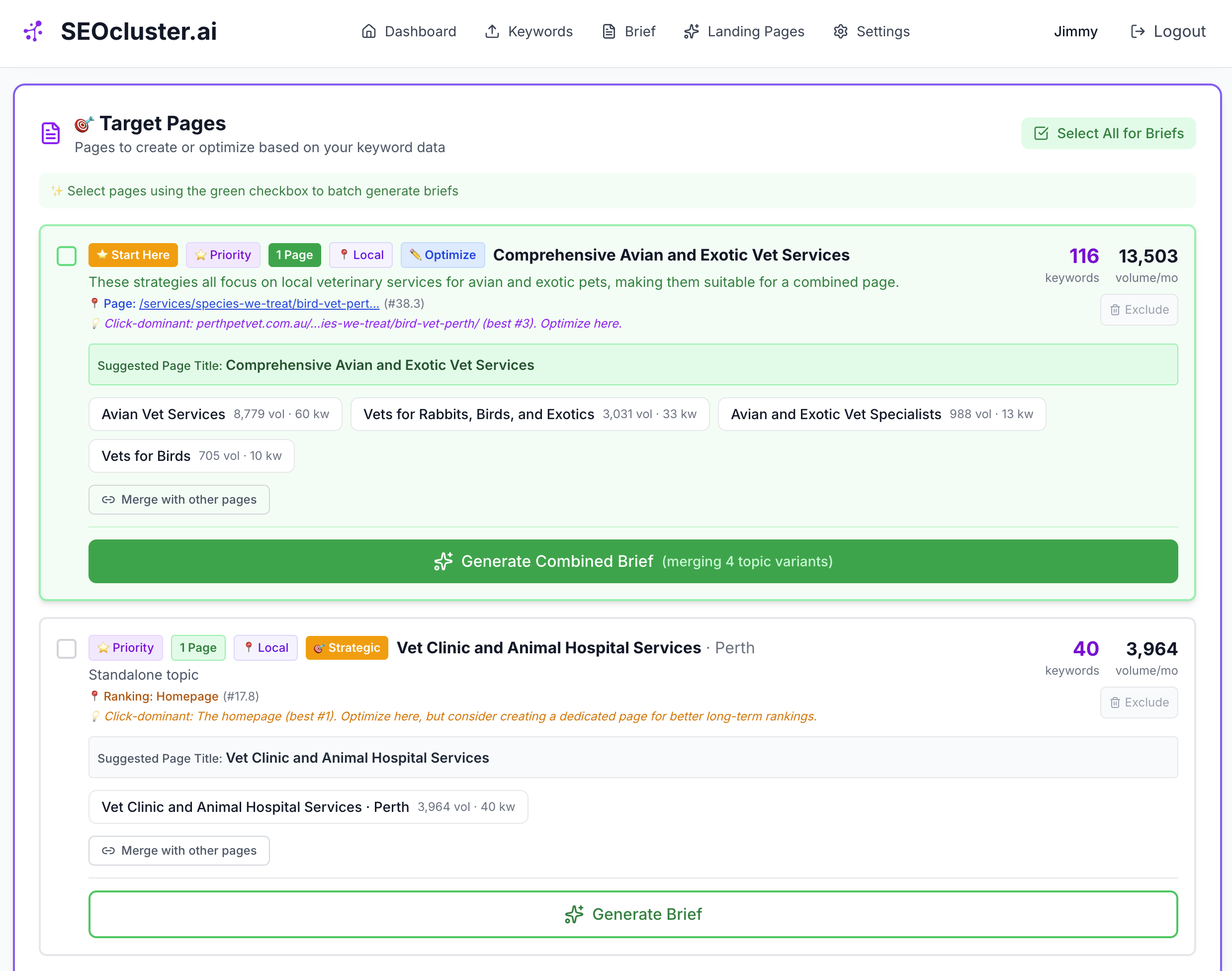
Target page recommendations after hybrid clustering. The top card shows 4 clusters automatically merged into one page by AI refinement. The second card flags a homepage ranking that needs a dedicated page. Client URLs are hidden for privacy.
Why Three Layers Matter
Most clustering tools use a single method — either semantic similarity or SERP overlap. Each has blind spots. Combining them with an AI layer produces results that match how an experienced SEO would structure the site:
Semantic Layer
Groups keywords by meaning using embeddings. "avian vet" and "bird veterinarian" land in the same cluster because they mean the same thing — even though they share no words.
SERP Validation
Checks whether Google already ranks the same URLs for related clusters. If two clusters share ranking pages, the system suggests merging them into one target page.
AI Refinement
An AI pass reviews the clusters and catches business-level groupings that algorithms miss. It recognised that "avian vet", "bird vet", "exotic pet vet", and "vets for rabbits and exotics" should all target the same page — even though they cover different animals.
How AI Caught What Algorithms Missed
The semantic layer correctly grouped keyword variants together — "avian vet perth" and "avian veterinarian" ended up in the same cluster. But it created separate clusters for different animal types: avian, exotic, rabbits, and birds.
From a pure NLP perspective, these are different topics. But from a business perspective, a local vet would serve all of them on one "Exotic & Avian Vet" page.
The AI refinement layer caught this. It merged 4 separate clusters into one target page:
AI-Merged: "Comprehensive Avian and Exotic Vet Services"
These 4 clusters were separate after semantic grouping. AI recognised they serve the same user need:
Combined: 116 keywords · 13,503 volume/mo · 1 page
Without AI merge: 4 weak pages instead of 1 strong one
Creating separate pages for "avian vet", "exotic pet vet", "vets for rabbits and exotics", and "vets for birds" would have split 13,500+ monthly searches across 4 thin pages. Each would cannibalise the others. One comprehensive page captures the full volume.
The Homepage Trap
The AI grouped the main avian and exotic clusters into one target page, but some related topics remained standalone — like "Exotic Animal Vet Services" (41 keywords, 2,798 volume). That's where homepage detection picks up the slack.
This cluster showed the homepage ranking at position #57. A basic clustering tool would say: "you already rank for this — optimise your homepage."
That's bad advice. Position #57 means Google is barely associating the homepage with this topic. Users aren't finding it. A dedicated page would rank far better.
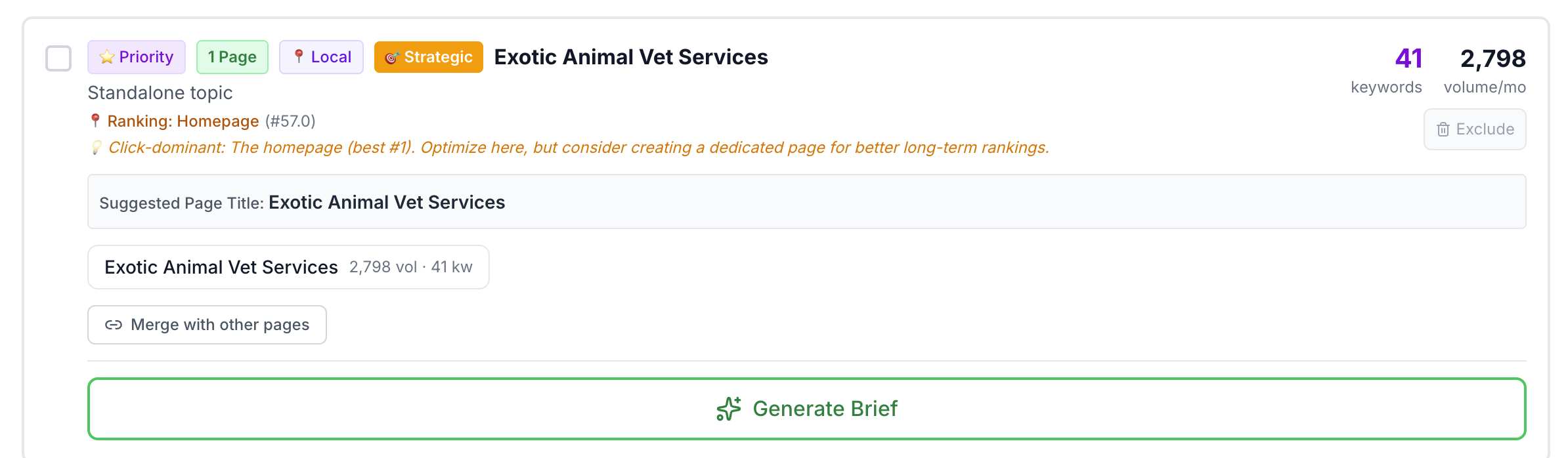
The system flags niche topics ranking poorly on the homepage and recommends creating a dedicated page instead of wasting effort optimising the wrong URL. Client URLs are hidden for privacy.
Smart detection: "Create a dedicated page"
Instead of telling the vet to "optimise the homepage" for exotic animals, the system flagged it: "Optimize here, but consider creating a dedicated page for better long-term rankings."
This distinction — optimise vs. create — is the difference between wasting effort on the wrong page and building the right one.
The Split Rankings Problem
Beyond page structure, the analysis revealed a cannibalization problem: 8 topics had multiple pages competing for the same keywords, splitting clicks and diluting rankings.
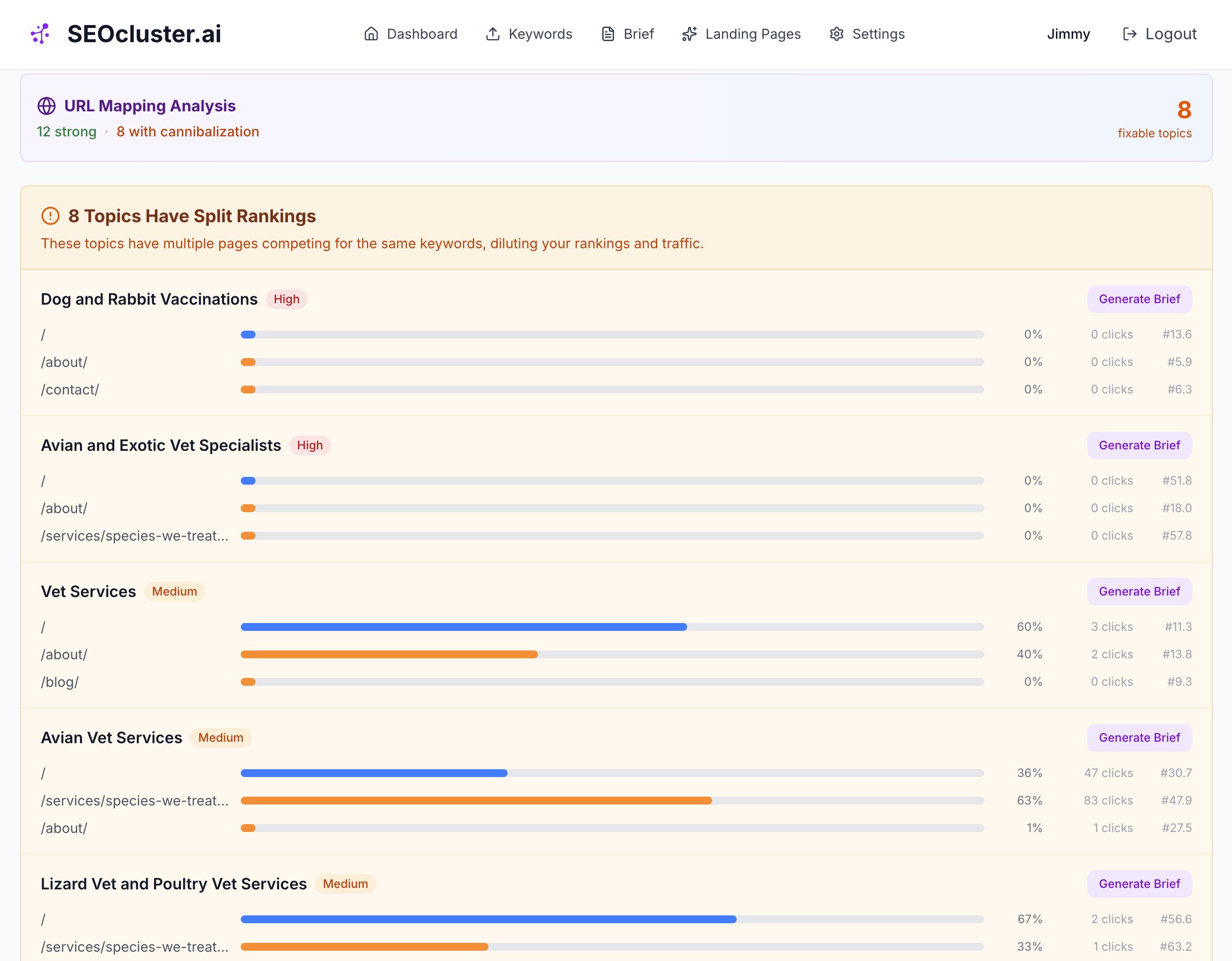
Cannibalization detection showing click share split across competing URLs. "Avian Vet Services" has 63% of clicks on the bird vet page and 36% on the homepage — a clear signal to consolidate authority onto one URL. Client URLs are hidden for privacy.
Take "Avian Vet Services" — 63% of clicks went to the bird vet service page, but 36% leaked to the homepage. For "Vet Services," the homepage captured 60% while the about page pulled 40%. Without this analysis, you'd never know your own pages were competing against each other.
Why "Unassigned" Keywords Matter
A significant portion of keywords were marked as "Unassigned" — meaning they don't need their own page.
This isn't a failure. It's strategic restraint.
Unassigned keywords include:
- Generic queries like "vet near me" — Google resolves these through existing pages
- Long-tail variations better suited for FAQ sections
- Brand-comparative queries that don't warrant new pages
Creating pages for these would dilute authority and create thin content.
The Quick Wins Hiding in Plain Sight
The biggest wins weren't from creating new content. They were from optimising pages that were already ranking but underperforming:
"bird vet perth" — Position #4.2
306 volume · +67 visits/mo potential
"vet perth" — Position #7.5
725 volume · +80 visits/mo potential
"vet" — Position #9.3
2,046 volume · +102 visits/mo potential
These keywords were already ranking in striking distance (positions 4–15). The opportunity was optimisation, not creation. The system surfaced 25 keywords like these as quick wins — achievable ranking improvements with concrete traffic estimates.
Total potential from 25 quick wins: +800 visits/mo
Without creating a single new page. Just optimising content that's already ranking.
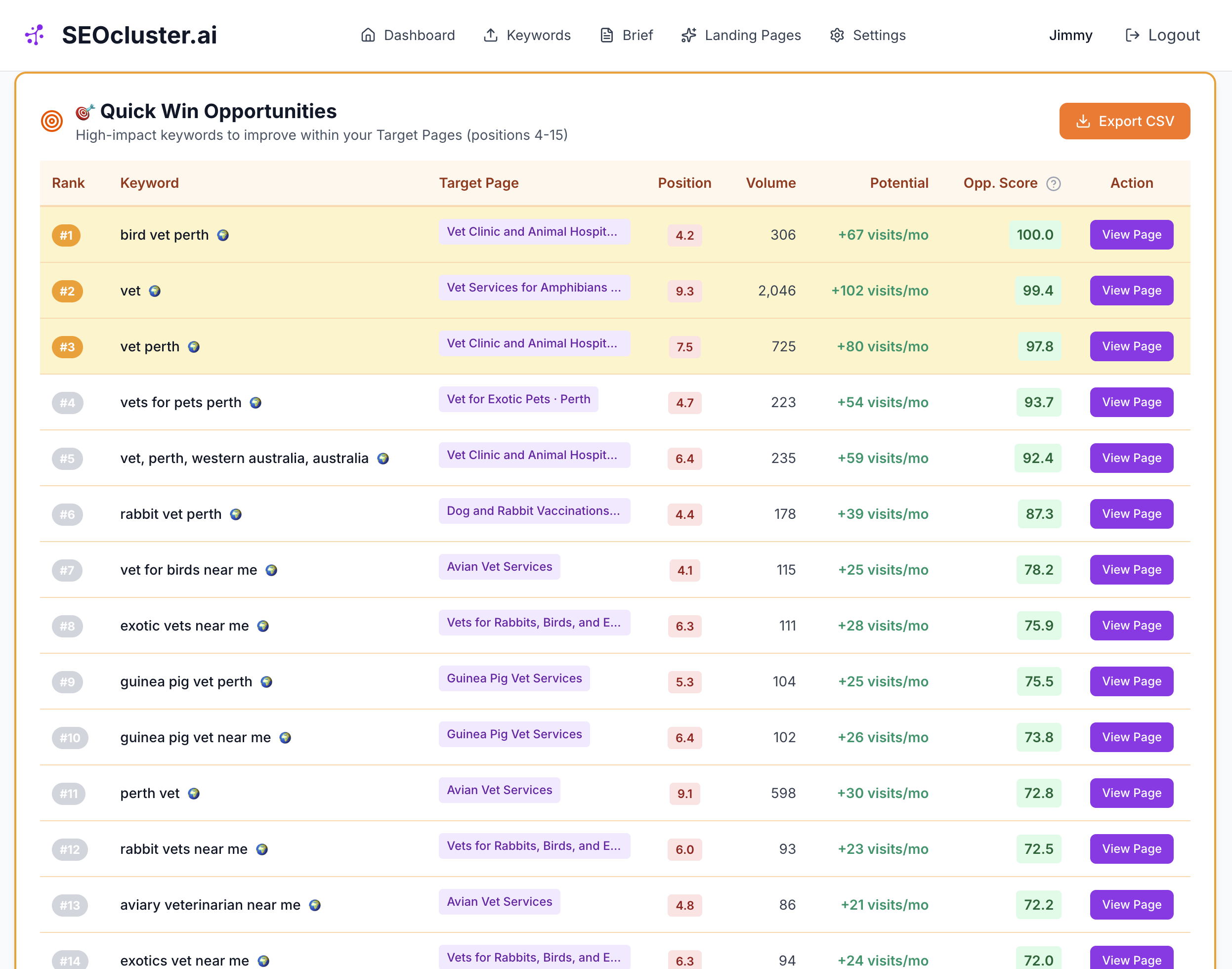
Quick win opportunities ranked by impact. Each keyword shows the target page, current position, search volume, and estimated traffic gain from reaching page one. Client URLs are hidden for privacy.
The Framework: Pages First, Keywords Second
This case study reinforced a different approach to SEO:
- 1Start with real GSC data — not keyword research estimates
- 2Cluster with multiple signals — semantic meaning, SERP overlap, and AI refinement together
- 3Decide pages first — then figure out which keywords belong to each
- 4Only create when the data demands it — don't build pages for niche topics when existing pages can absorb them
This case study was produced using SEOcluster.ai to force page-level decisions from real Google Search Console data, rather than keyword lists.
Key Takeaway
SEO isn't about creating pages for every keyword, and it's not about compressing everything into as few pages as possible either. It's about finding the right number of pages — the structure Google actually wants — and building each one to be comprehensive and authoritative.
Frequently Asked Questions
How many pages does a local business website really need?
It depends on the data, not assumptions. In this case study, 2,000+ keywords collapsed into just 18 target pages. The right number is determined by how Google is already grouping your queries and which topics genuinely need dedicated pages.
What is keyword cannibalisation?
Keyword cannibalisation occurs when multiple pages on your site compete for the same search queries. In this case study, 8 topics had split rankings — with clicks divided between the homepage, service pages, and even the about page. This splits authority and hurts rankings for all competing pages.
What is hybrid keyword clustering?
Hybrid keyword clustering combines semantic embeddings (grouping by meaning), SERP validation (checking Google's actual results), and AI refinement (catching business-level groupings). This multi-layer approach produces more accurate results than any single method alone.
Should every keyword have its own page?
No. Many keywords are vocabulary variants of the same intent. In this case study, 4 separate clusters about avian, exotic, and bird vet services were merged into one target page with 116 keywords and 13,503 monthly searches. Four separate pages would have cannibalised each other.
What does "Unassigned" mean in keyword clustering?
Unassigned keywords don't need their own page. They're typically generic queries (like "vet near me") that Google resolves through existing pages, or long-tail queries better suited for FAQs and internal links.
Why did the homepage rank for niche topics?
Homepages often pick up incidental rankings for specific topics, especially when no dedicated page exists. But ranking at position #57 for "exotic animal vet" isn't useful — a dedicated page would rank much higher and actually drive traffic.
Curious how Google is grouping queries on your own site?
This analysis was produced using SEOcluster.ai — a hybrid clustering tool that combines semantic analysis, SERP validation, and AI refinement to turn real GSC data into page-level decisions.
If you want to explore your own data, you can connect your GSC property and see the same type of analysis used in this case study.
Explore your GSC dataNo credit card required.