Keyword Clustering & Page Strategy Tool Built on Google Search Console Data
Turn real Search Console queries into Target Pages — your page roadmap showing exactly which pages to create, optimise, or merge. Detect cannibalization, generate data-driven content briefs, and track directional Search Console results after you implement.
SEOcluster.ai is an AI keyword cluster tool that uses your Google Search Console data to group SEO keywords into semantic clusters, detect keyword cannibalization, generate AI-powered content briefs, and check before/after visibility — without pretending SEO is perfectly causal.
No credit card required · Read-only GSC access · See Target Pages in minutes
2,000+ → 18
GSC queries collapsed into focused Target Pages for a local vet site
GSC-native
Decisions from real clicks, impressions, and ranking URLs — not third-party estimates
Agency-ready
Multi-site Pro plans, exports, and white-label strategy drafts for client delivery
Built for
What you get after clustering
From thousands of queries to a clear page roadmap
Import GSC data and get Target Pages — which topics deserve a page, which URLs already own them, and where split rankings are hurting performance. Then brief, implement yourself, and check Search Console later for directional before/after movement.
Turn GSC data into an SEO workflow
SEOcluster.ai connects search queries, ranking URLs, content briefs, audits, and migration planning so each feature supports the same page-level decision process.
Semantic keyword clustering software
Group queries by meaning, intent, and GSC page evidence.
Keyword cannibalization checker
Find competing URLs, split rankings, and ownership conflicts from GSC.
AI SEO audit tool
Prioritize technical SEO and AI search readiness fixes.
URL migration mapper
Map migrations, protect high-value URLs, and export redirect plans.
Why Real Search Console Data Produces Better Clusters
Most keyword tools were built for a search era where ranking meant targeting isolated keywords. Today, Google and AI-powered search surfaces prioritise topical authority and semantic intent.
Traditional Keyword Tools
SEOcluster.ai
| Traditional Keyword Tools | SEOcluster.ai |
|---|---|
| Rely on scraped or third-party keyword databases | Uses your real Google Search Console queries |
| Group keywords by word similarity or rules | Hybrid clustering: semantic + SERP + AI refinement |
| Encourage one page per keyword | Encourages one page per intent cluster |
| Manual clustering in spreadsheets | Automated, scalable clustering |
| Hard to spot cannibalisation | Detects and prevents cannibalisation |
| Output raw keyword lists | Outputs content plans, briefs, and pages |
| Deliver clusters — you decide what to do next | Delivers page-level decisions backed by real click data |
From Keyword Clusters to Page Decisions
Most tools stop at clusters. SEOcluster.ai connects the dots — from raw GSC queries to a clear action plan for every page on your site.
Clusters mapped to URLs
Each cluster is matched to your existing pages using GSC performance data.
Cannibalization detected
Overlapping URLs are flagged with severity scoring so you can review page ownership before conflicts cost traffic.
Try the cannibalization checkerMerge recommendations
Clusters sharing the same target URL or topic are grouped with one-click merge.
Page-level action plan
Every Target Page gets a clear action: create, optimize, strengthen, or consolidate.
Why SEOcluster.ai Exists
Built for Both Classic SEO & Generative Search
Search behavior is changing. AI-powered search results often cite sources rather than send traffic directly.
SEOcluster.ai helps you produce content structures that are:
- Clear in topic coverage
- Aligned with semantic intent
- Structured for citation in AI overviews
- Optimized for organic ranking and search recall
- Semantic clustering builds topical authority — the #1 driver of visibility in Google and AI Overviews.
Works for Local and Non-Local Content
Your content strategy may include:
- Service pages
- Location-based landing pages
- Topical authority clusters
- Blog / resource articles
- Buyer intent clusters
SEOcluster.ai adapts to both.
Key Capabilities
Target Pages
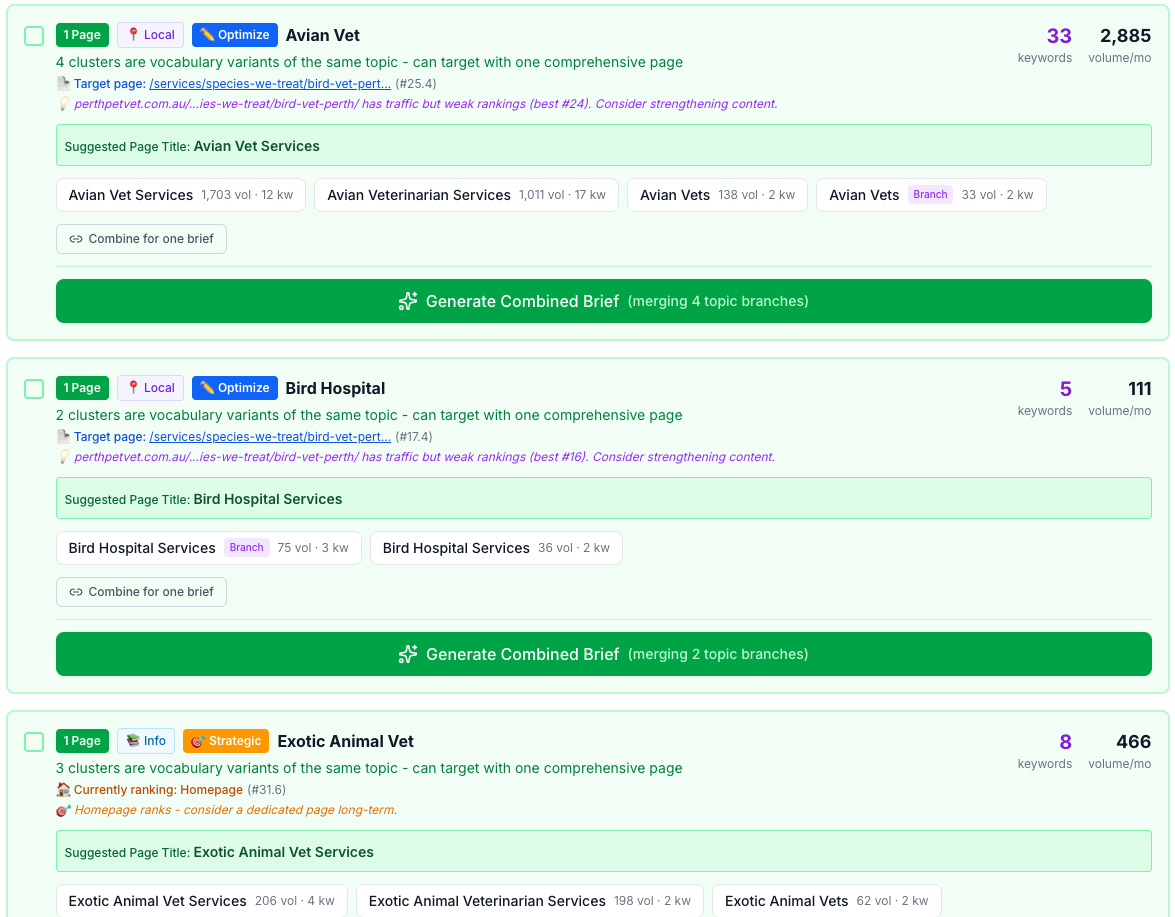
Stop thinking in clusters — start thinking in pages. Target Pages shows you exactly:
- • Which pages to create for new topics
- • Which pages to optimize (existing coverage)
- • Which pages to merge (topic branches)
AI identifies which clusters are branches of the same intent and recommends combining them — so you build authoritative pages, not thin ones.
Hybrid Keyword Clustering
Clusters keywords by meaning and search intent, combining semantic analysis with SERP validation and AI refinement — not single-method grouping. Modern SEO is intent-based: clusters help you rank in organic search and appear in AI-generated results.
AI Content Briefs & Pages
Generate combined briefs for Target Pages — merging topic branches into one comprehensive content plan:
- • Structured heading outline with format recommendations
- • FAQ section & schema markup
- • Traffic estimates from real GSC data
- • Topical authority link map with real URLs & anchor texts
- • AI-ready answer blocks for zero-click search
Then generate publish-ready long-form content in Markdown or Word — easy to paste into any CMS.
Beyond recommendations
Build SEO pages with a feedback loop
Most SEO tools stop at recommendations. SEOcluster helps you go further: cluster keywords into Target Pages, generate briefs, turn findings into actions, and check Search Console later to see whether results moved in the right direction.
SEO results are noisy — so outcome tracking reports directional before/after Search Console changes instead of pretending every ranking move was caused by one edit. You implement changes yourself; nothing is auto-published.
1. Target Pages
Decide page ownership, not just topic groups.
2. Briefs & actions
Implementation-ready plans you execute yourself.
3. Track impact
Search Console before/after checks after you implement.
Striking Distance & Quick Wins
Identify keywords ranking in positions 4–15 and prioritize them with a scoring system powered by search volume, CTR gap, ranking position, and local intent signals.
Local Intent Detection
Automatically detects city and regional modifiers using a global location database. Ideal for local businesses and multi-location SEO.
Cannibalization Detection
Detect overlapping clusters, score severity, and get AI recommendations to review, differentiate, merge, or monitor before you compete with yourself.
Actions & outcome tracking
Maps each cluster to your existing URLs using GSC data, recommends the right action (optimise, create, or resolve conflicts), then lets you mark work implemented and review directional Search Console before/after results later.
See Actions for cannibalizationTopic Matrix & Hierarchy
Visualize your entire topic landscape — primary topics, supporting subtopics, and long-tail variations — and plan your content architecture at a glance.
SEO Strategy Draft
Export a working PDF draft with executive summary, Target Pages, quick wins, and split-ranking review. Pro users get white-label PDF and editable DOCX for review-ready delivery.
Topical Authority Engine
Every brief includes a bidirectional link map — which pages to link FROM and TO, with suggested anchor texts — built automatically from your site's topic structure. Build topical authority without manual mapping.
Competitor Gap Analysis
See which competitors rank for each topic cluster and where you're missing. Content gaps are flagged directly on your Target Pages so you know exactly where to act.
URL Migration Mapper
Planning a site redesign? Upload your old and new site crawls in Screaming Frog CSV format — the tool automatically maps every old URL to its best new equivalent using content similarity scoring. Prioritises redirects by actual GSC traffic so your highest-value pages are covered first. Flags pages Google has indexed that are missing from the new site structure — the orphans that kill traffic after a migration.
Learn about URL migration mapping See the redirect mapping workflowTechnical Site Audit with AI Analysis
Crawl any website and get an AI-powered audit report covering 22 issue types across 12 SEO categories. Connect Google Search Console to detect orphan pages with zero internal links.
What the Audit Covers
Indexability & Crawlability
Broken links, redirect chains, noindex issues, orphan pages, missing canonicals
On-Page SEO
Missing or duplicate titles, thin meta descriptions, heading hierarchy, image alt text
Performance & Page Experience
Page size, render-blocking resources, mobile readiness, schema markup validation
AI Readiness Report
Assessment of how well your content is structured for citation by AI search engines like ChatGPT and Perplexity
How It Works
Enter your URL or upload a Screaming Frog export
The built-in crawler scans up to 5,000 pages. Or upload an existing crawl CSV.
Connect GSC for orphan page detection
Optional. Cross-references crawled URLs with GSC data to find pages receiving search traffic but missing internal links.
Get prioritized issues + AI report
Issues scored by severity and impact. AI generates a plain-English summary with recommended fixes and an AI readiness score.
Works alongside clustering. Run an audit to find technical issues, then cluster your keywords to build a content strategy — two complementary workflows in one tool.
Free plan includes 1 audit per month with AI reports
How It Works
See it in action — 60 seconds
No spreadsheets. No manual clustering. Just real Search Console data transformed into content plans.
Connect Search Console or Upload Keywords
Import keywords directly from Google Search Console, or upload a CSV file.
AI Creates Target Pages
Keywords are clustered by search intent, then grouped into Target Pages — the actual pages you need to create, optimize, or merge. Related topic branches are automatically combined. Each Target Page shows recommended action based on your existing URL performance.
Generate Combined Briefs & Pages
Generate comprehensive content briefs for each Target Page — merging all topic branches into one plan. Then create publication-ready content pages. Pro unlocks batch generation and advanced content structuring.
Simple, Transparent Pricing
Start free — upgrade only if it's valuable
No contracts. Cancel anytime.
Built For:
Freelance SEOs who need to produce client-ready briefs fast
Agencies managing multiple locations or service areas
In-house marketers who need to scale content with limited time
Business owners who want clearer visibility into search opportunities
Free
For individuals getting started
- 1 Google Search Console site
- 1,500 keywords per dataset
- 3 clustering runs/mo
- 2 Briefs/mo • 1 Page/mo
- 1 Site Audit/mo (500 pages)
- URL Migration mapping (1 run/mo)
- Semantic clustering
- GSC integration
- Export to CSV & Word
- Single-brief generation only
No credit card required
Essential
For solo SEOs & small businesses
- Up to 5 GSC sites
- 25,000 keywords per dataset
- 50 clustering runs/mo
- 50 Briefs/mo • 10 Pages/mo
- 30 Site Audits/mo (2,000 pages)
- URL Migrations (10 runs/mo)
- Content Patches (20/mo) — copy-pasteable page fixes
- Batch Brief Generation
- SEO Strategy Draft (PDF)
- Everything in Free
- Priority email support
Free plan first · upgrade when ready · cancel anytime
Pro
Unlimited client sites. White-label exports.
- Unlimited GSC sites — no per-client fees
- 50,000 keywords per dataset
- 120 clustering runs/mo • 120 Briefs/mo
- 30 Content Pages/mo
- 80 Site Audits/mo (5,000 pages)
- Unlimited URL Migrations
- Content Patches (Claude Sonnet AI) — copy-pasteable page improvements
- MPNet High-Accuracy Clustering — present confident results to clients
- White-label SEO Strategy Draft (PDF + DOCX) — no SEOcluster branding
- Everything in Essential
- Premium support
Best for multi-client agencies · cancel anytime
All plans include GSC clustering, Target Pages, cannibalization signals, and exports. Site audit and migration tools are included as supporting workflows.
Not sure yet? Try the interactive demo or read how 2,000 queries became 18 pages.
Common Questions
Is my Google Search Console data safe?
Yes. SEOcluster.ai uses read-only access to your Google Search Console data. We never modify your site, submit URLs, or change any settings. You can revoke access at any time from your Google account permissions. Your data is processed securely and never shared with third parties.
Do I need SEO experience to use this?
No. The platform guides you step-by-step through clustering, content briefs, and page generation.
Does this work outside of local SEO?
Yes. Local SEO detection is automatic, but clustering and content briefs work for national and informational search strategies as well.
What does the Site Audit check?
The Site Audit crawls your website (up to 5,000 pages) and checks 22 issue types across 12 categories including broken links, redirect chains, missing titles, thin content, image alt text, schema markup, and page experience signals. If you connect Google Search Console, it also detects orphan pages that receive search traffic but have no internal links pointing to them. An AI report summarizes findings with prioritized recommendations and an AI readiness score.
Does SEOcluster.ai help with site migrations and redirects?
Yes. The URL Migration Mapper lets you upload your old and new site crawls in Screaming Frog CSV format and automatically generates a confidence-scored redirect map. It cross-references Google Search Console data to prioritise redirects by actual traffic value — so your highest-value pages are always covered first. It also flags pages Google has indexed that are missing from the new site structure, giving you the complete picture before you launch.
What's included in the Free plan?
The Free plan includes full clustering features, 3 clustering runs, 2 content briefs, 1 content page, and 1 site audit per month.
What's the difference between Essential and Pro?
Essential ($29/mo) gives you 5 GSC sites, 25,000 keywords per dataset, batch brief generation, 30 site audits per month, and SEO Strategy Draft PDF exports. Pro ($99/mo) unlocks unlimited GSC sites for multi-client agencies, 50,000 keywords per dataset, MPNet high-accuracy clustering, 80 site audits per month with 5,000-page crawls, and white-label SEO Strategy Drafts (PDF + DOCX) with no SEOcluster branding.
Can I export the data?
Yes. All plans include CSV and Word (.docx) export for clustering and briefs. Paid plans include SEO Strategy Draft PDF exports. Pro users can also export editable DOCX versions.
What are Target Pages?
Target Pages are the actionable output of clustering. Instead of seeing 100+ clusters, you see the specific pages you should create, optimize, or merge. Each Target Page combines related keyword clusters (topic branches) into one comprehensive content plan.
How do I turn clusters into pages?
SEOcluster.ai's Target Pages feature automatically groups related clusters and recommends which pages to create. You can then generate combined content briefs that merge all topic branches into one comprehensive brief.
Can I track results after I implement changes?
Yes. After you implement work yourself, Actions can save a Search Console baseline and later compare before/after metrics for the same page window. Results are directional only — Search Console is noisy, so SEOcluster.ai does not pretend every ranking move was caused by one edit. Nothing is auto-published to your site.
Why does SEOcluster.ai focus on clustering and search intent?
Google and AI search prioritise topical authority over isolated keywords. Clustering by intent creates content that ranks higher in organic search and gets cited in AI Overviews. Learn more in our complete guide to SEO clustering.
Does SEOcluster.ai detect keyword cannibalization?
Yes. SEOcluster.ai works as a keyword cannibalization checker using click-share analysis from your Google Search Console data. It scores severity using the HHI (Herfindahl-Hirschman Index), shows which URLs are competing for the same queries, and recommends whether to merge, redirect, or differentiate competing pages.
Does SEOcluster.ai optimize content for AI search engines?
Yes. All content briefs apply traditional SEO and AI-search-aware fundamentals: clear structure, useful visible answers where relevant, matching structured data, and evidence-backed page decisions. No brief can guarantee citations in Google AI Overviews, ChatGPT, or Perplexity.