SEO Clustering Example: From Search Console Data to Content Plan
See exactly what SEOcluster.ai produces — real keyword clusters, prioritised opportunities, and publish-ready SEO content built directly from your Google Search Console data.
No credit card required
What Goes In — And What Comes Out
Input
- •Google Search Console property (secure, read-only)
- •Or uploaded keyword CSV
Output
- Target Pages — pages to create, optimise, or merge
- Supporting keyword clusters by intent
- Quick win and striking distance opportunities
- Combined content briefs for Target Pages
- Full landing pages and long-form content
- SEO Strategy Draft (PDF)
- Site Audit — technical issues, AI readiness report
- URL Migration Map — confidence-scored redirects
One connection turns raw queries into a clear content plan.
Example: Target Pages — Your SEO Action Plan
Instead of working through hundreds of keyword clusters, SEOcluster.ai identifies the exact pages you should create, optimise, or merge.
Each Target Page combines related keyword clusters (topic branches) into one actionable content plan — preventing cannibalisation and thin pages by design.
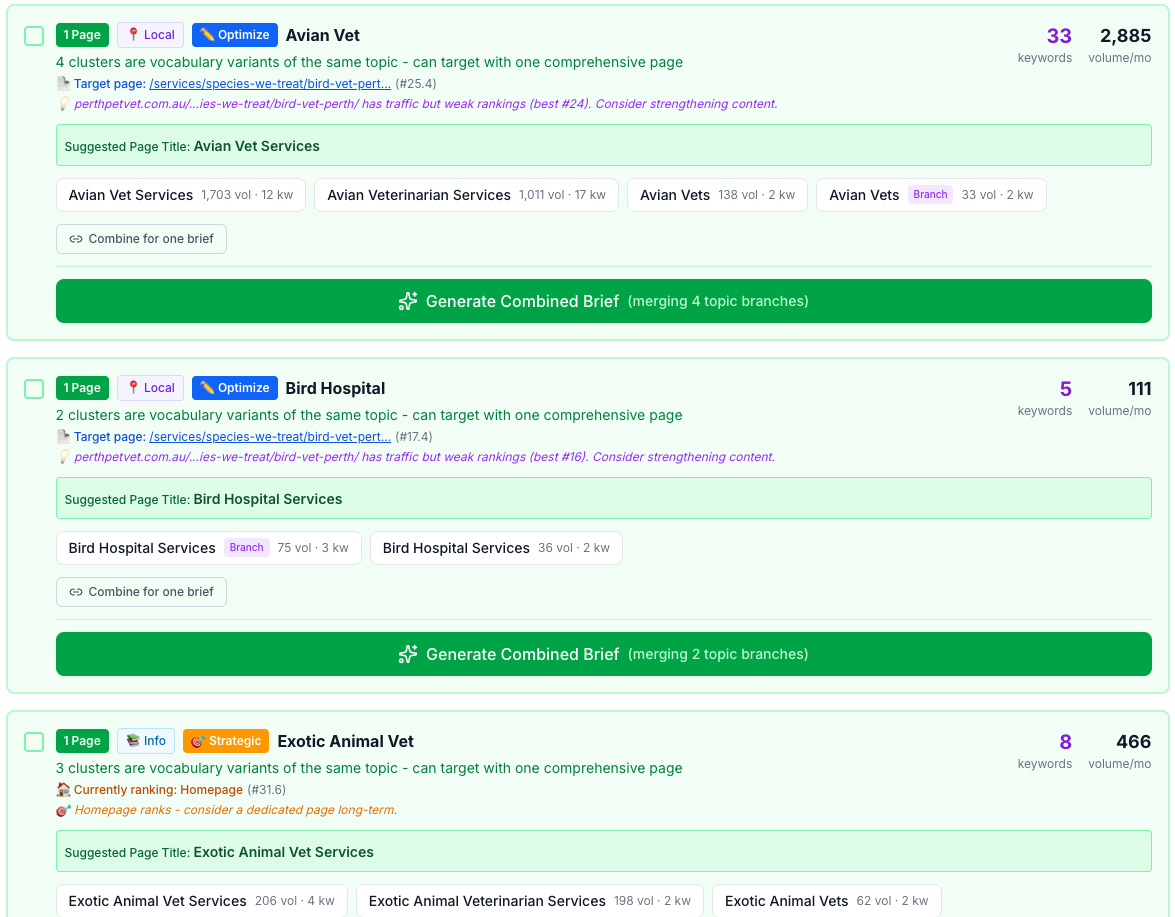
Example from a live seocluster.ai GSC run — Target Pages with create / optimise / merge decisions.
🆕 Create
New topics with no existing coverage — build from scratch.
⚡ Optimise
Existing pages that can be strengthened with cluster keywords.
🔗 Merge
Topic branches that should be combined into comprehensive pages.
Target Pages are the strategic output of clustering — not raw data. The underlying clusters, matrix view, and scoring all feed into this actionable summary.
Example: Matrix View & Cluster Hierarchy
The Matrix View supports your page strategy — a structured overview of your entire topic landscape. Clusters are organised into Primary, Secondary, and Long-tail tiers, helping you understand why certain Target Pages are recommended and how topics relate to each other.
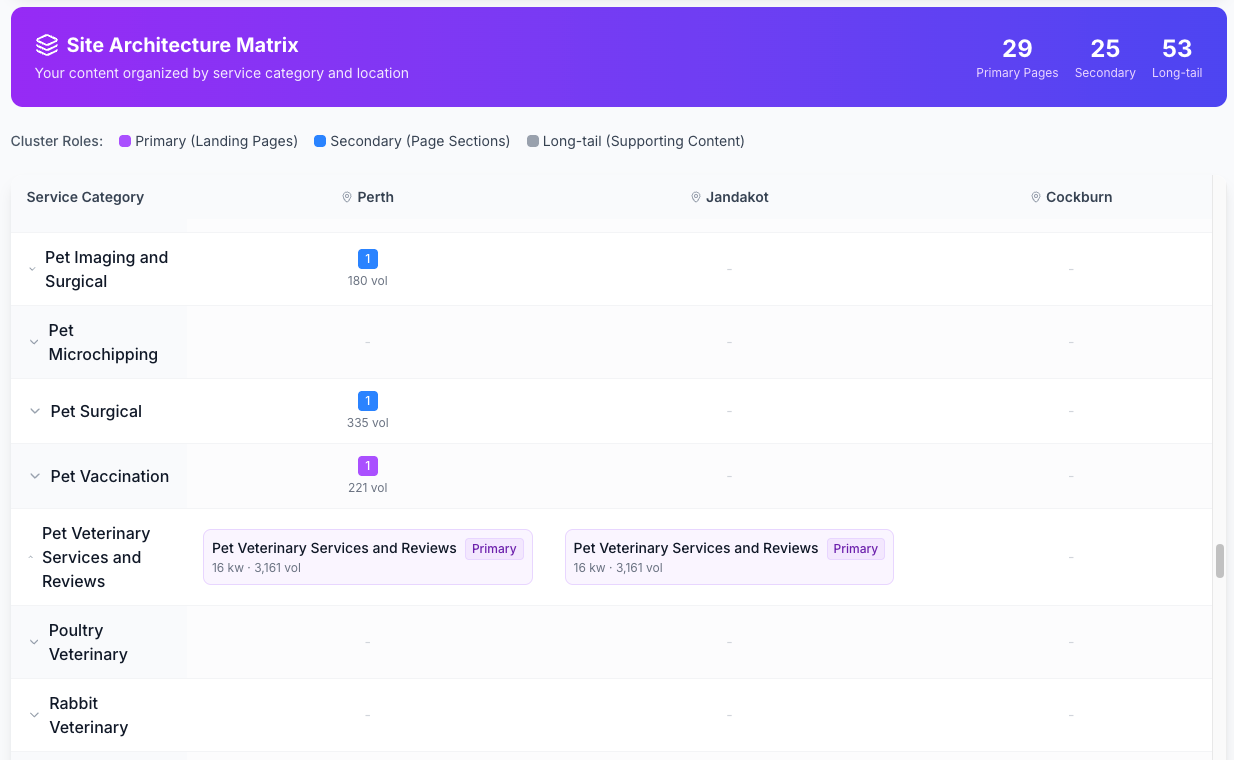
Example output. URLs and client details are hidden for privacy.
⭐ Primary Topics
Core category clusters that anchor your content strategy — your most important landing pages.
📄 Secondary Topics
Supporting subtopics that build depth around primary themes.
📝 Long-tail Variations
Niche intents and specific queries to capture targeted traffic.
The Matrix View makes it easy to identify gaps in your topic coverage and plan content that builds comprehensive topical authority — without getting lost in individual keyword details.
Example: Smart Recommendations (5-Factor Scoring)
The Opportunity Score is a prioritisation framework — it helps you decide what to work on next, not predict rankings. SEOcluster.ai ranks clusters using a composite score built from five real performance signals.
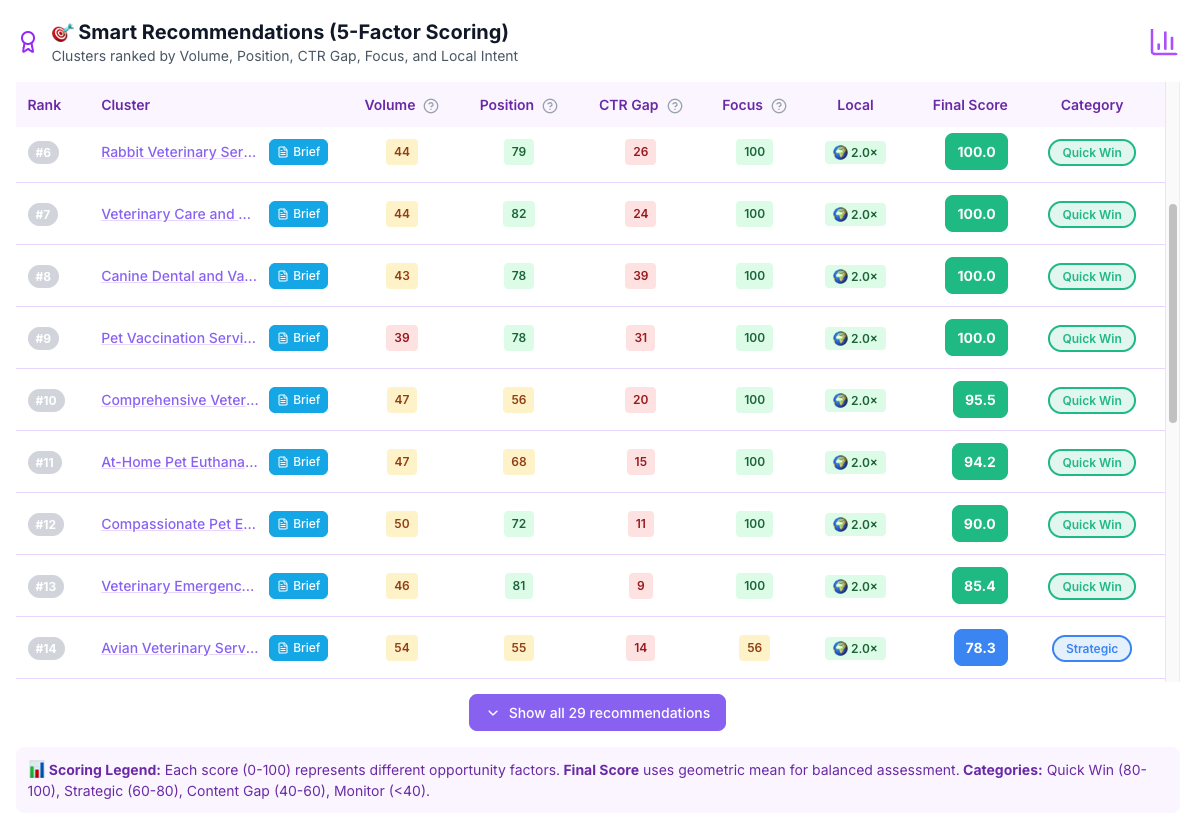
Example output. URLs and client details are hidden for privacy.
Signals included:
Search Demand
Current Position
CTR Gap
Topic Focus
Local Intent
Clusters are categorised as Quick Win, Strategic, Content Gap, or Monitor based on their composite score.
Example: Quick Wins & Striking Distance Opportunities
Keywords that are already close to page one represent your fastest path to more traffic. SEOcluster.ai surfaces these opportunities based on actual GSC performance data.
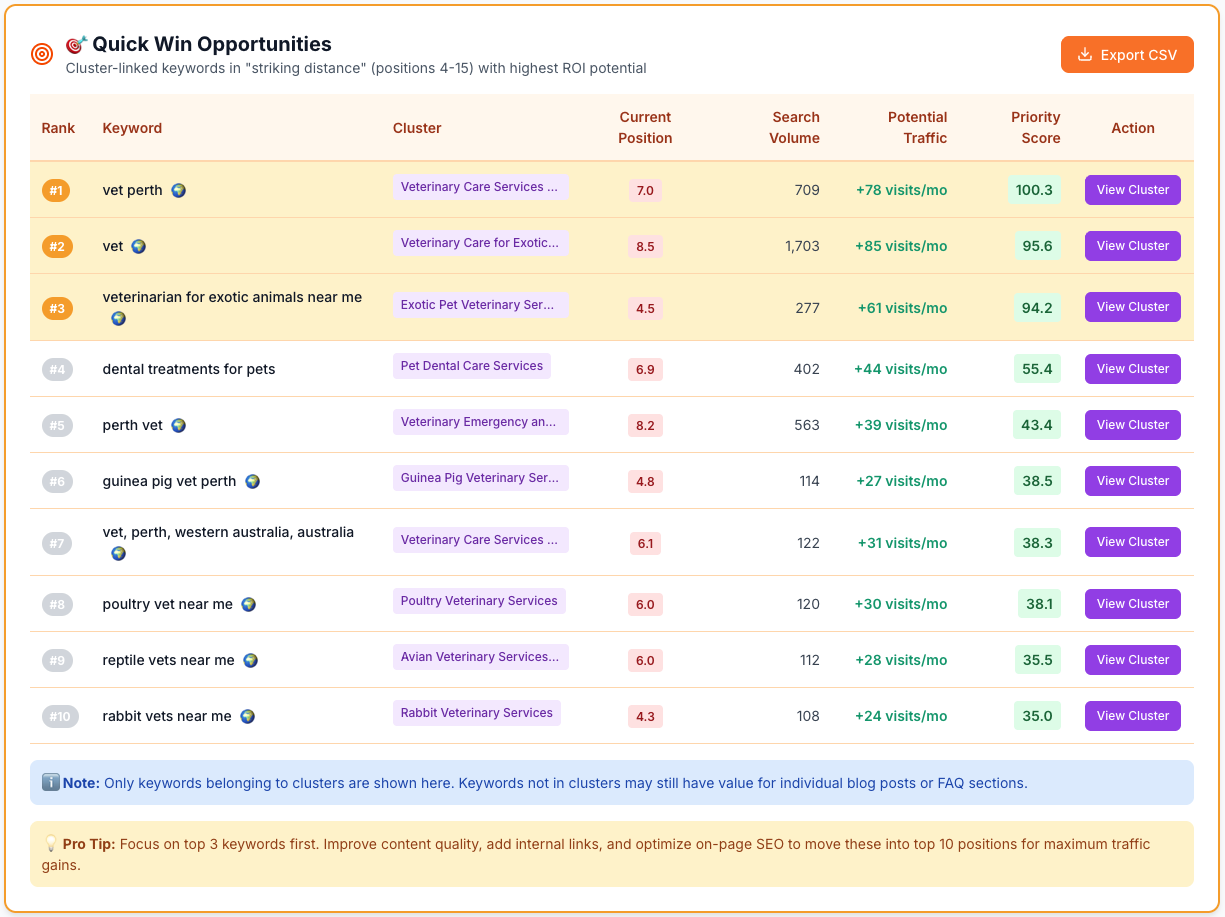
Example quick wins from a live seocluster.ai GSC run — position, impressions, and owner page.
Focuses on keywords already close to page one
Surfaces the fastest traffic gains
Based on actual GSC performance, not estimates
Example: Semantic Keyword Clusters
The List View shows the underlying cluster data — every keyword grouped by meaning and search intent. This is the source layer that powers the Matrix View, recommendations, and content briefs.
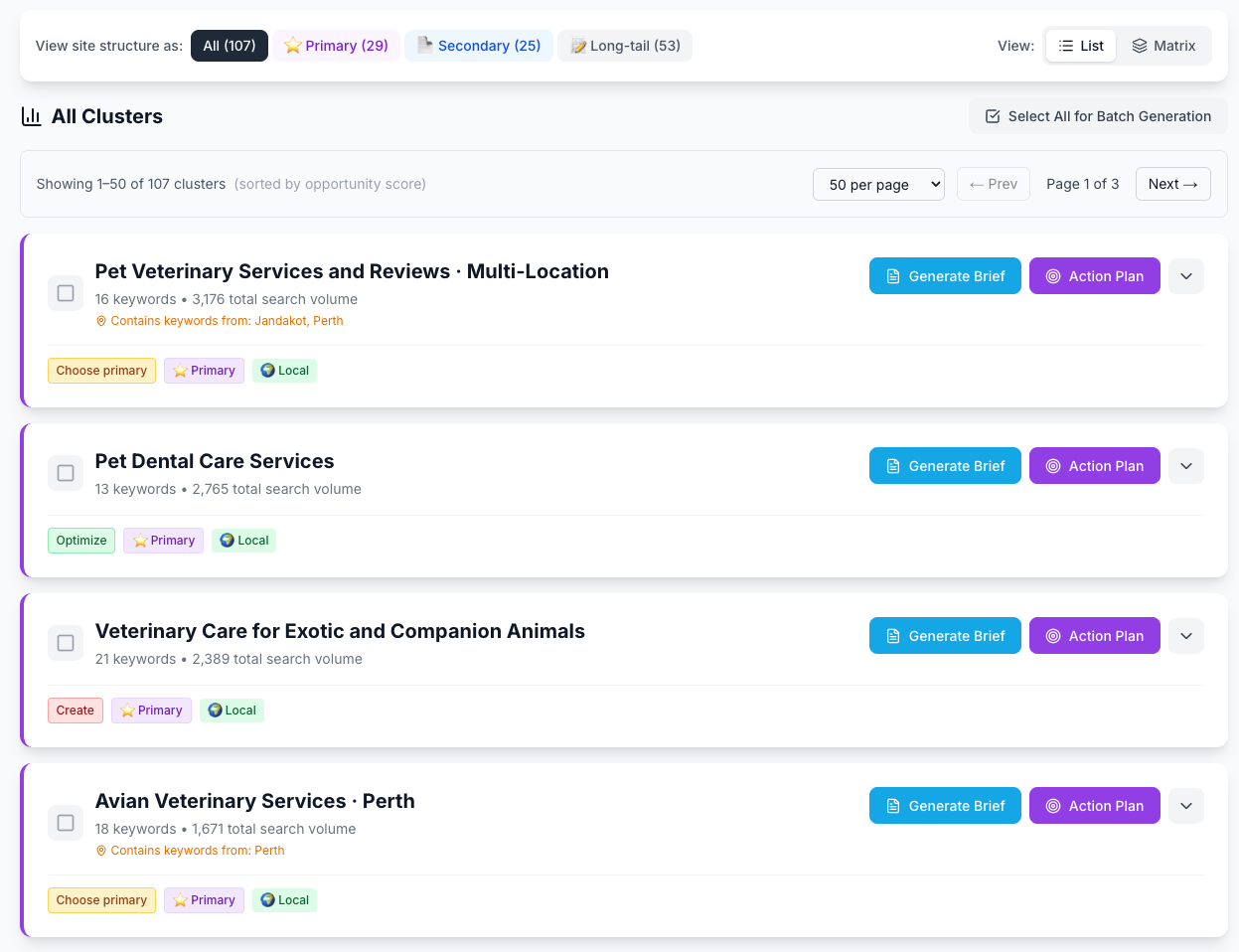
Example output. URLs and client details are hidden for privacy.
Keywords are grouped by meaning and search intent, not just shared words. Each cluster maps to a single page or content asset.
Why Local Intent Matters
Traditional SEO tools may see "avian vet" ranking at position 22 and mark it as underperforming.
But they often miss that "avian vet perth" ranks position 1–2, meaning the site is already highly visible locally.
SEOcluster.ai detects local modifiers across 6M+ locations, separates local from national intent, and applies a local opportunity boost (internal prioritisation weighting, not a ranking guarantee) — so real opportunities are never hidden by misleading averages.
Example: URL Mapping & Action Recommendations
Each keyword cluster is automatically mapped to the URLs already ranking in Google Search Console. SEOcluster.ai then recommends one of five specific actions based on performance data.
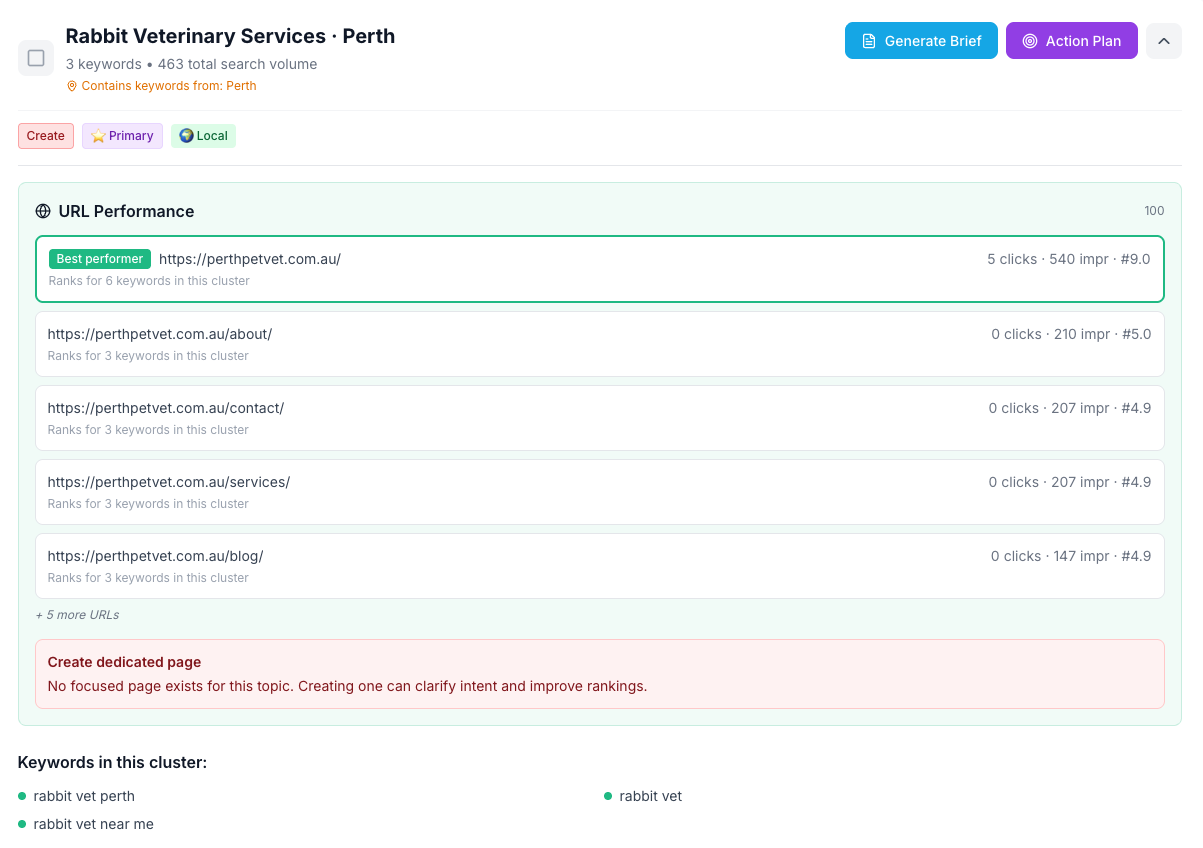
Example output. URLs and client details are hidden for privacy.
Five recommended actions:
Optimize
Page ranks well — strengthen with cluster keywords
Strengthen
Untapped potential — improve content depth
Choose Primary
Multiple URLs compete — pick one and consolidate
Create
No URL exists — build a new page for this intent
Monitor
Page performs well — watch and maintain
URL mapping works automatically when you connect Google Search Console — no manual setup required. Each cluster shows its mapped URLs and recommended action in the dashboard.
Example: Non-Local & Commercial Intent Clusters
Not all search intent is local. SEOcluster.ai automatically distinguishes between local, national, and commercial-intent queries and clusters them accordingly.
In non-local datasets, clusters are prioritised without geographic weighting, focusing instead on search demand, current ranking position, CTR opportunity, and topic focus.
This ensures national content strategies, product pages, reviews, and guides are evaluated on their true optimisation opportunity — not diluted by local modifiers.
Example: AI-Generated SEO Content Brief
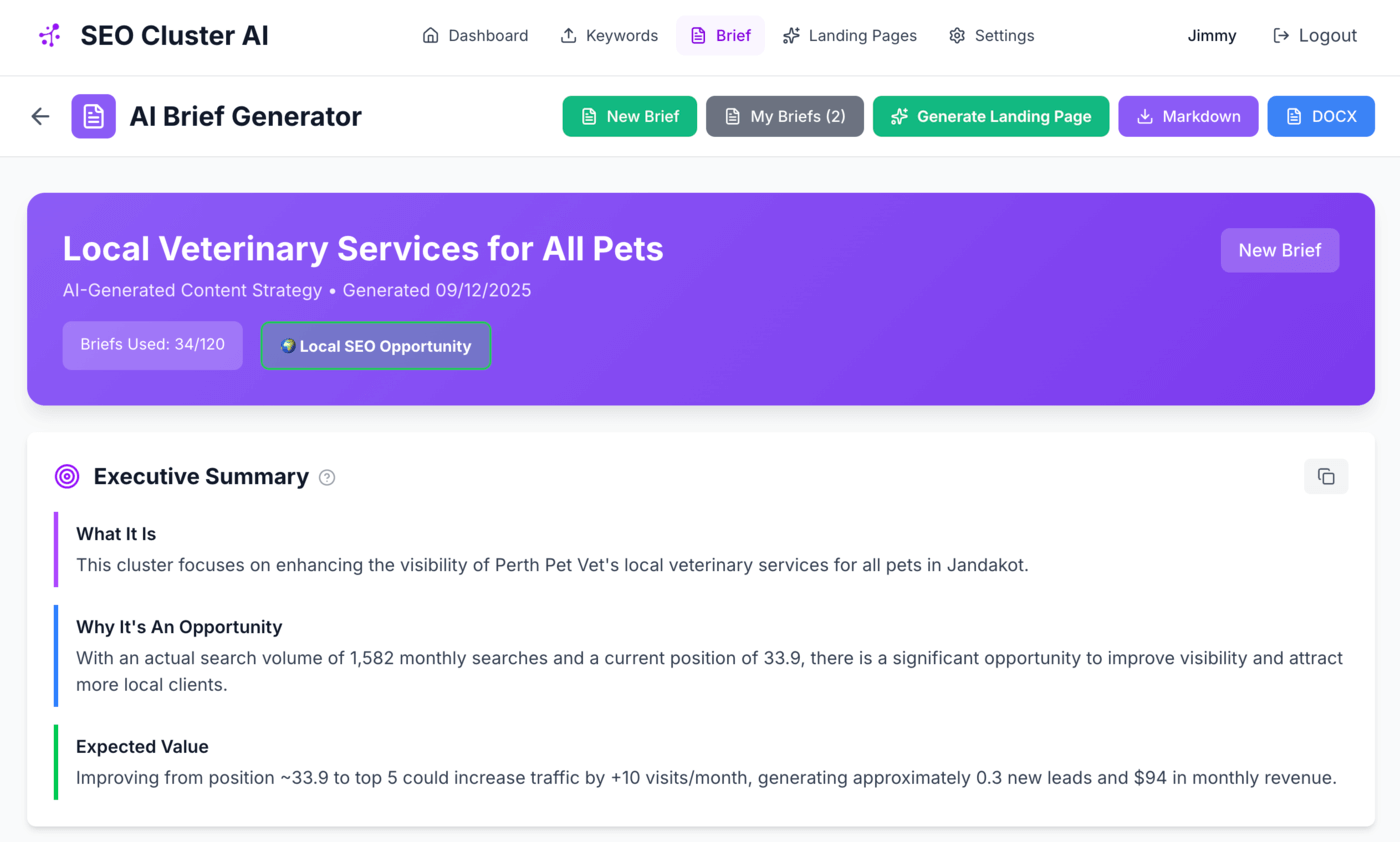
Example revamp brief for a live owner URL (AI SEO Audit) — structure and implementation path.
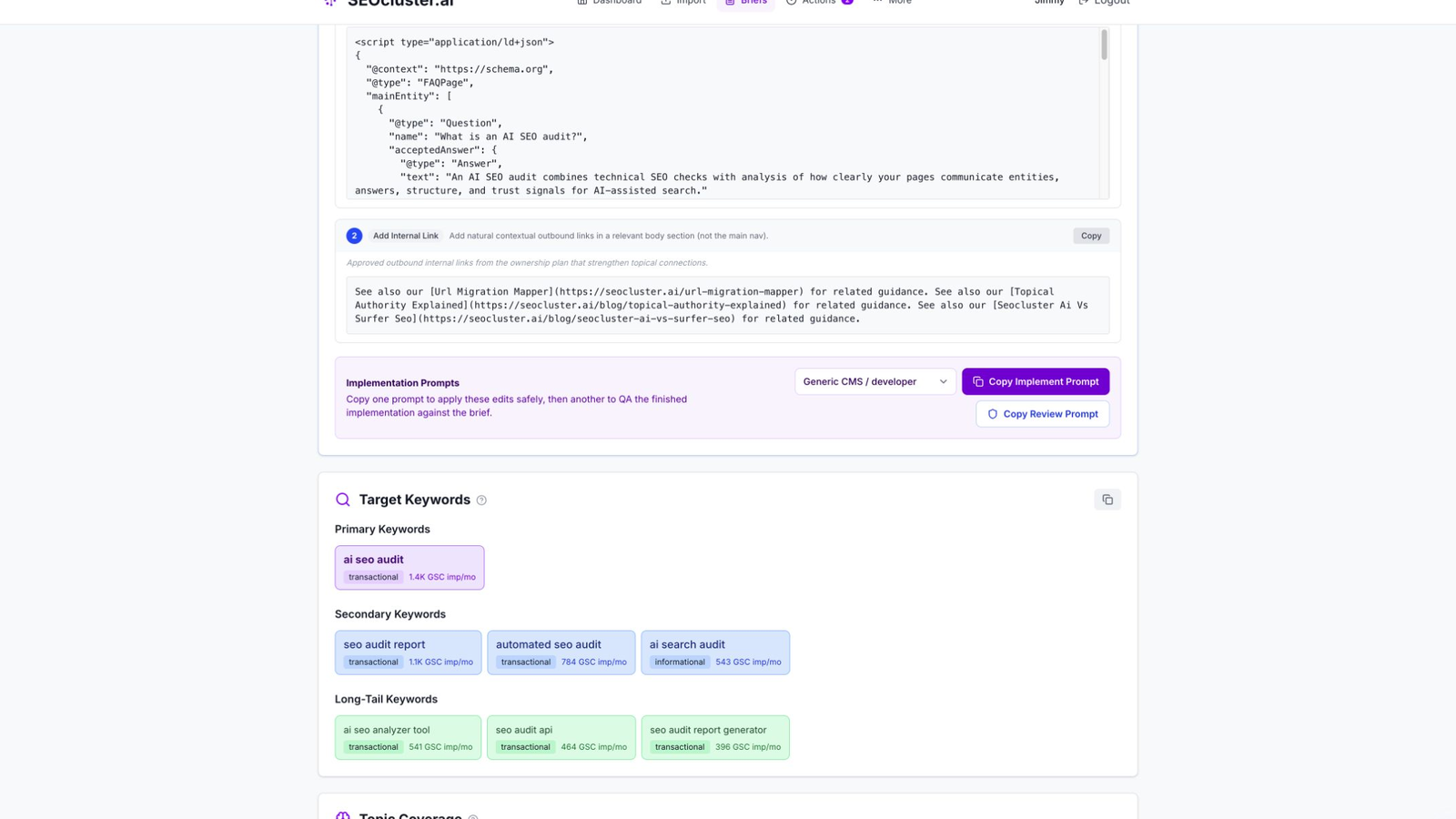
Page Edits: implementable patches for the selected ranking URL (not a blank-page draft).
Each brief includes:
- Page title & meta suggestions
- Structured H1–H4 outline
- Key talking points
- Intent-aligned FAQ section
- Schema guidance (FAQ, LocalBusiness, Article)
- Internal linking cues
Additional context
Briefs automatically incorporate your saved business profiles, ensuring services, locations, and branding remain consistent.
Pro users can also customise ROI assumptions such as conversion rate and customer value.
Example: Publish-Ready Landing Page
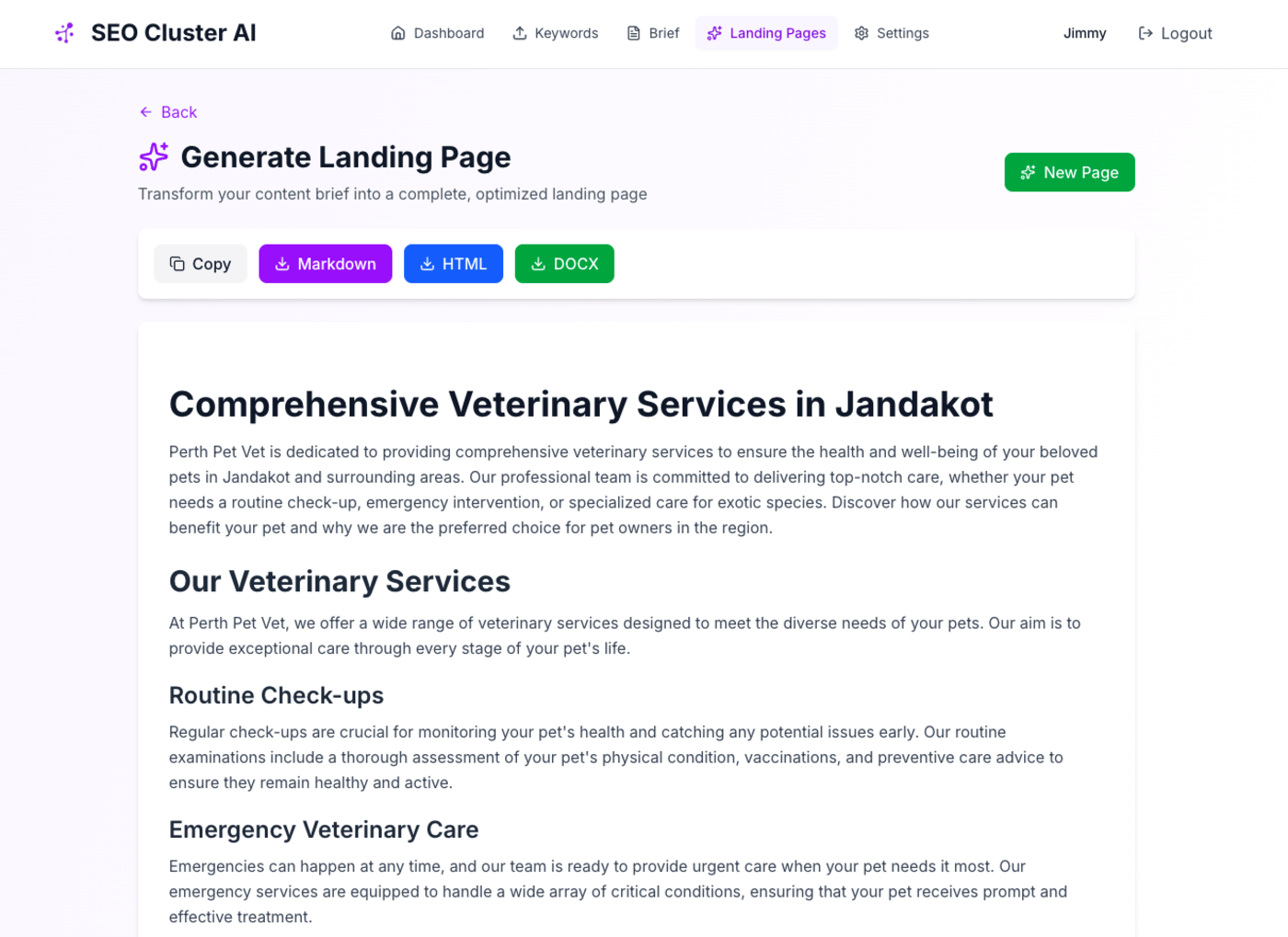
Example generated page. URLs and client details are hidden for privacy.
Pages are generated in clean, editable formats so you retain full control over publishing, editing, and optimisation.
Example: Site Audit — Technical Health & AI Readiness
Enter any URL and the built-in crawler analyses every page for technical SEO issues, content quality, and AI search readiness. Results include a scored issue breakdown and two AI-generated reports: a technical audit and an AI readiness assessment.
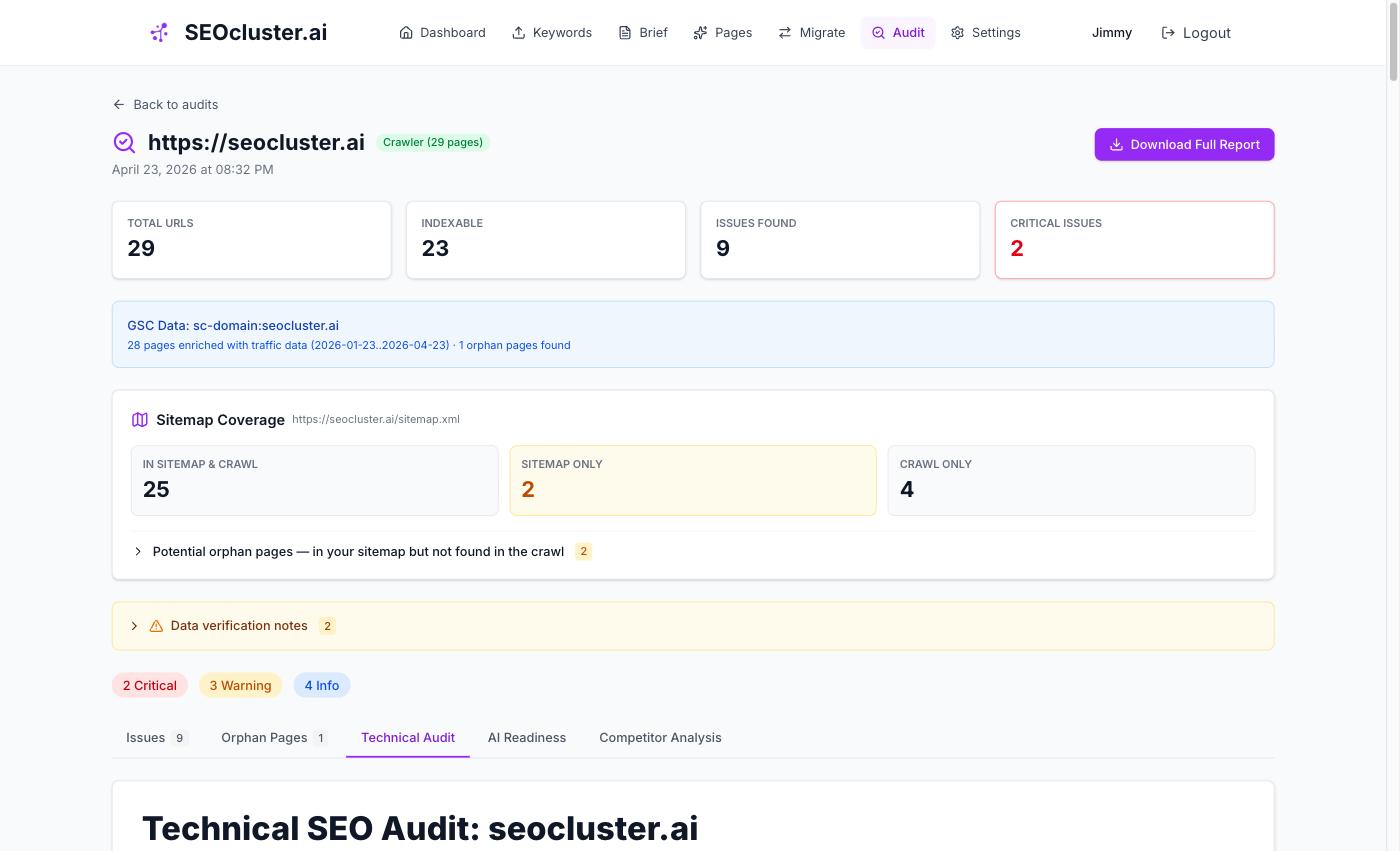
Example audit output. URLs and client details are hidden for privacy.
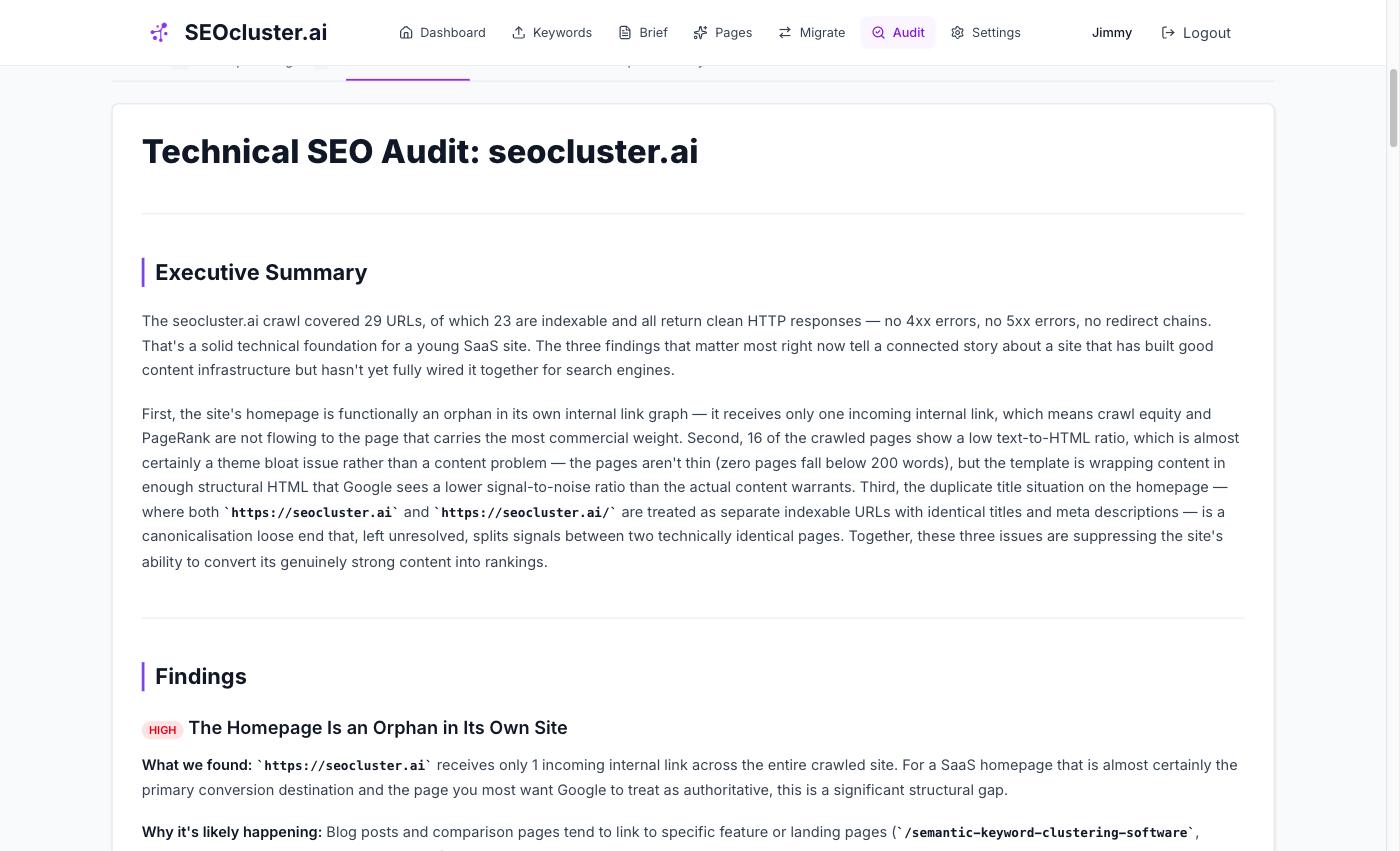
Technical Audit Report
AI-generated analysis of crawl findings with prioritised fixes. URLs are hidden for privacy.
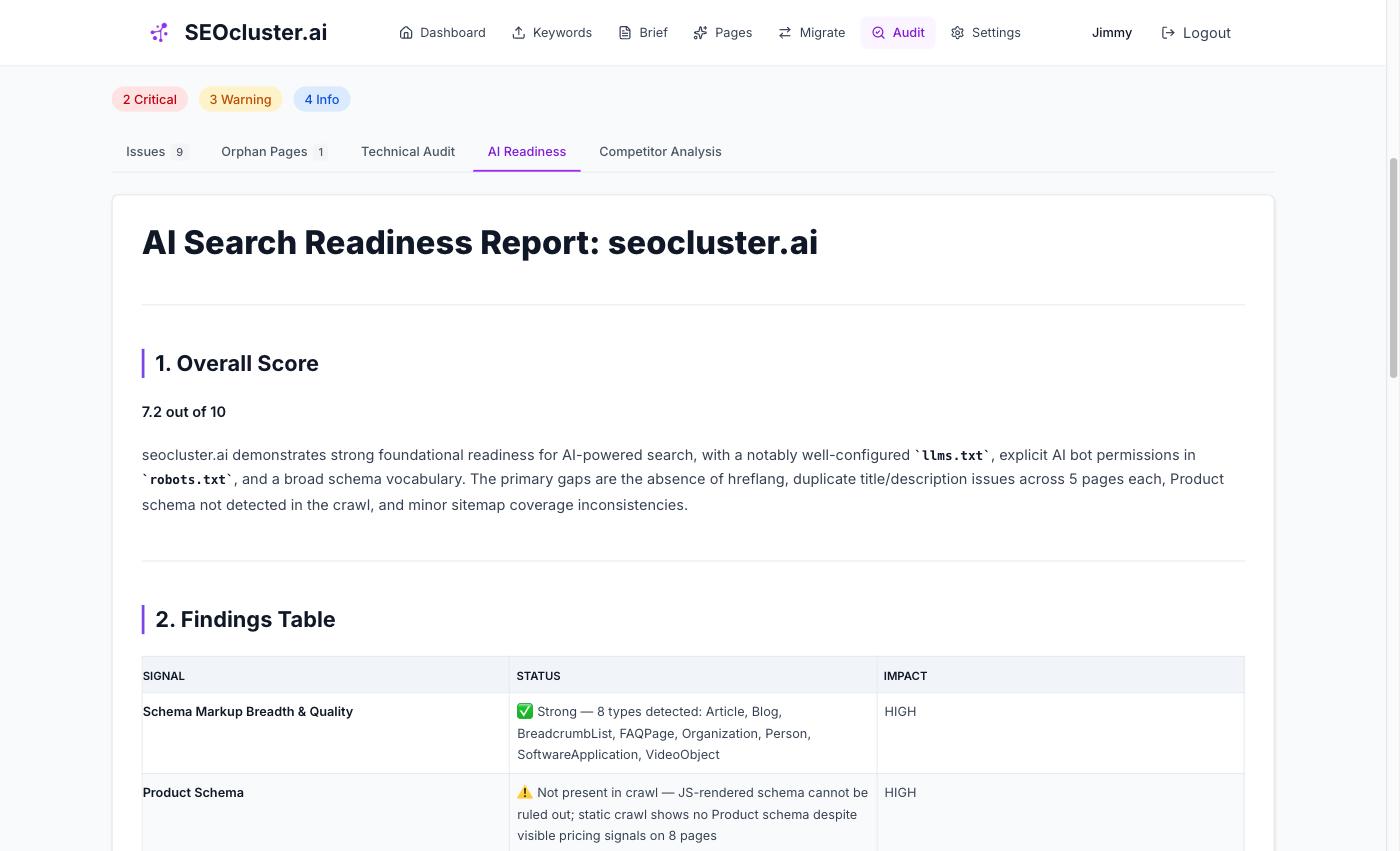
AI Readiness Assessment
How visible your site is to AI search engines. URLs are hidden for privacy.
22 Issue Types
Across 12 categories including meta tags, content, schema, images, and page experience.
GSC Enrichment
Connect Search Console to add real traffic data and detect orphan pages Google has indexed.
Competitor Analysis
Pro users get a head-to-head comparison against top organic competitors in their market.
Two input methods: crawl any live website directly, or upload Screaming Frog CSV exports for sites you've already crawled. Both produce the same comprehensive analysis.
Explore the AI SEO audit tool Review the AI search audit workflowExample: URL Migration Mapper
Planning a site redesign or domain migration? Upload your old and new site crawls in Screaming Frog CSV format and get a confidence-scored redirect map in minutes. The tool cross-references Google Search Console data to prioritise redirects by actual traffic value.
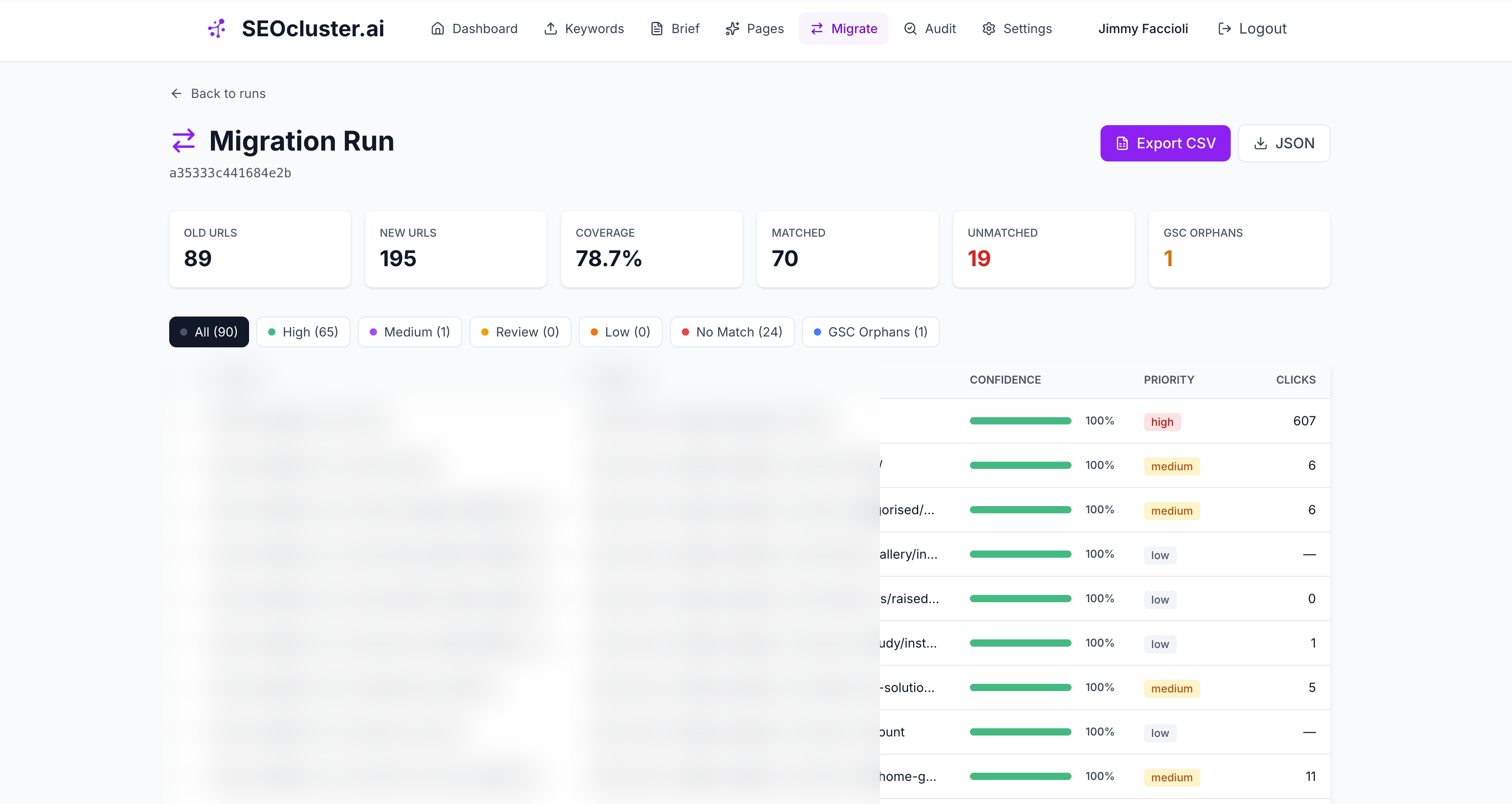
Confidence Scoring
Each redirect is scored by content similarity so you can review borderline matches.
Traffic Prioritisation
GSC data ranks redirects by actual traffic value — highest-value pages first.
Orphan Detection
Flags indexed pages missing from the new site structure before you launch.
Optional AI review checks borderline matches and flags potential issues. The executive summary gives you a coverage percentage and highlights any gaps before you go live.
What These Outputs Enable
Ready to Generate Your Own SEO Content Plan?
Start Free with Google Search ConsoleNo credit card required
Common Questions
Is this real Google Search Console data?
Yes. SEOcluster.ai uses your actual Search Console queries via secure, read-only access.
Can I export these outputs?
Yes. Clusters and briefs export to CSV and Word (.docx). Paid plans include SEO Strategy Draft PDF exports. Pro users can also export editable DOCX versions.
Does this work outside of local SEO?
Yes. Clustering works for local, national, and informational SEO strategies.
Does SEOcluster.ai include a site audit?
Yes. The built-in crawler analyses any website for 22 technical SEO issue types across 12 categories. It generates two AI-powered reports: a technical audit with prioritised fixes and an AI readiness assessment showing how visible your site is to AI search engines like ChatGPT and Google AI Overviews.
Learn the strategy behind these outputs
Start Building Better SEO Content Today
Start Free with Google Search ConsoleNo credit card required · Read-only access · Cancel anytime